
SSL Native X-Saturator Review: Focused Analog-Style Color
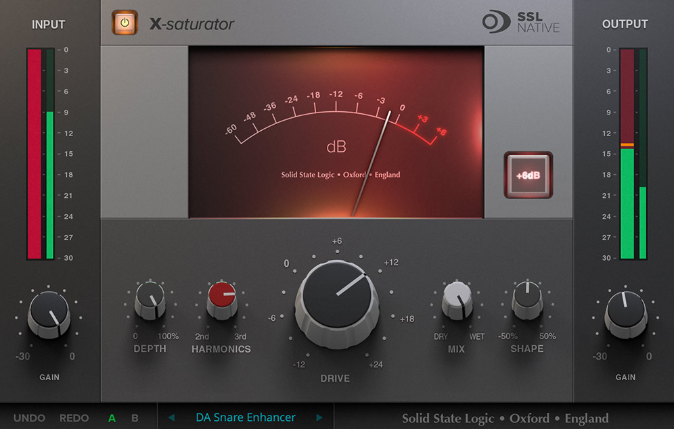
A focused harmonic shaper that lets you move between valve-like second-order richness and transistor-like third-order bite, making it equally useful for subtle mix enhancement and deliberate destruction.
8.4 / 10
SSL Native X-Saturator offers fast control over tube-like richness and transistor-like bite. We examine how it performs on drums, bass, vocals and buses.
What is SSL Native X-Saturator?
X-Saturator is SSL’s compact answer to the broad category of analog-style harmonic enhancement. Its central strength is control over second- and third-order harmonics: the former tends to read as rounder and more tube-like, while the latter contributes a harder, more forward character associated with solid-state circuits. Drive, depth and wet/dry control make it possible to use the same processor as a restrained sweetener or a creative distortion effect.
Sound and musical character
At low drive levels, X-Saturator can add presence and perceived loudness without the obvious fuzzy edge of a guitar-style distortion. Second-order emphasis works well when a vocal, pad or bass needs warmth and cohesion. Third-order emphasis is more effective for bringing percussion, aggressive synths and midrange bass information forward on small speakers. The plugin can become forceful when driven, but it retains a mix-oriented feel: the result is usually more controlled than unruly. Parallel blending is the safest way to retain transients while adding harmonic energy.
Workflow and real-world use
The uncluttered control set makes auditioning quick. Start by level matching the input and output, choose the harmonic balance, then raise drive until the change is clearly audible before backing it off. On drum buses, a small amount can increase urgency; on a DnB bass bus, it can create upper harmonics that translate beyond sub-heavy systems. Automation of drive or mix can also turn it into a transition effect without introducing a separate distortion chain.
SSL Native X-Saturator: Pros and cons
Pros
Direct control over second- and third-order harmonics
Wide range from subtle enhancement to assertive distortion
Fast interface with parallel blending
Cons
No multiband processing or extensive device models
Less adventurous than dedicated sound-design distortion suites
Level changes demand careful matched comparisons
Limitations and buying considerations
It does not provide the multiband architecture, elaborate modulation or large menu of device models found in broader saturation suites. That simplicity is part of its appeal, but sound designers wanting unpredictable waveshaping may outgrow it. Because added harmonics change perceived level, careless comparisons can lead to over-processing.
Who should buy SSL Native X-Saturator?
Producers who value fast, controllable analog-style color on individual tracks and buses, particularly vocals, drums, bass and synth material.
Final verdict
A disciplined saturation tool with a wide usable range. It is most convincing when used as a tone-and-density control rather than as an all-purpose distortion laboratory.
Check the current price and compatibility: View SSL Native X-Saturator on Plugin Boutique